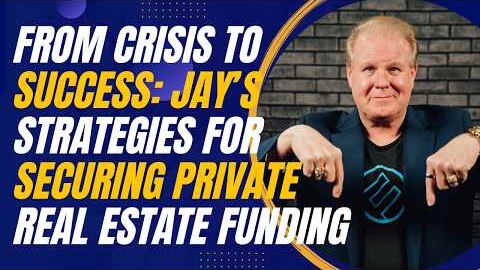
From Crisis to Success: Jay Conner’s Strategies for Securing Private Real Estate Funding
5 View

- Publish Date:
- August 3, 2026
- Category:
- How to Invest
- Video License
- Standard License
- Imported From:
- Youtube
#realestate #privatemoney #jayconner
***Guest Appearance
Credits to:
https://www.youtube.com/watch?v=zZ7z96vEHC0&t=116s
“IEP 95: How Jay Conner Raised $2M in 90 Days Without Asking for a Dime ”
https://www.youtube.com/@iconiqentrepreneurs
The conversation focused on how strategic thinking, relationships, and a teaching mindset can revolutionize your approach to raising capital for real estate investments. One concept discussed was the pivotal moment of transition from relying on traditional banks to leveraging Private Money. This shift didn't just bring new funding—it fundamentally transformed business operations and investor confidence.
The discussion explored the story of encountering an unexpected obstacle: a bank suddenly closing a line of credit without warning, jeopardizing hundreds of thousands in potential profit. The choice was clear—give up, or think differently.
A key theme that emerged was problem-solving through connection. The question posed was simple yet profound: "Who do you know that can help you with your problem?" This became a guiding principle, not just in business finance, but for tackling any challenge in life—financial, health-related, or relational.
Several points were raised, including the importance of separating the act of “asking for money” from the act of “teaching an opportunity.” Instead of pitching deals, the strategy is to educate potential private lenders on the workings and advantages of Private Money, including tax-advantaged options like self-directed IRAs.
This approach transforms previously skeptical or uninformed contacts into eager participants, as illustrated by stories where simply sharing the process led to significant investment without a single direct “ask” for money.
The conversation revealed that by focusing on service and education, investors create a dynamic where money begins to “chase” them, not the other way around. There’s an emphasis on credibility—having a trustworthy team, like reputable real estate attorneys and CPAs, signals to potential partners that you’re running a real business, not just dabbling.
For new investors, the advice is practical: start with your immediate sphere—friends, church members, colleagues, and local clubs. These are relationships already built on trust and communication, a critical element for acceptance and success.
A key takeaway was the mindset shift that rejecting the “pitch” mentality removes anxiety and fear of rejection. Since the approach is value-driven and educational, even those who don’t invest still leave the conversation better informed. This philosophy applies well beyond real estate, offering a framework for ethical and sustainable business growth in any field.
In closing, the episode championed the idea that enough is never enough “when it’s not about you.” Success is not measured solely in dollars, but in the difference you make—serving others, teaching skills, and building lasting relationships.
Timestamps:
00:00 Dealing with a financial crisis
04:07 Importance of Private Money
07:54 Transitioning from mobile homes to real estate
12:46 Connecting with Jeff for advice
15:29 Securing Private Money for Real Estate
17:31 Teaching Private Lending Program
22:32 Teaching the private lending program
26:29 Finding Investors by Referral
27:22 Discussing interest rates with Wayne
33:31 Private lending opportunities
36:34 Grandfather's influence and early life
38:28 Early work experiences and drive
40:52 Raising Private Money With Jay Conner
Private Money Academy Conference:
https://www.ThePrivateMoneyConference.com
Free Report:
https://www.jayconner.com/MoneyReport
Join the Private Money Academy:
https://www.JayConner.com/trial/
Have you read Jay’s new book, Where to Get the Money Now?
It is available FREE (all you pay is the shipping and handling) at https://www.JayConner.com/Book
What is Private Money? Real Estate Investing with Jay Conner
http://www.JayConner.com/MoneyPodcast
Jay Conner is a proven leader in real estate investing. Without using his own money or credit, Jay maximizes creative methods to buy and sell properties with profits averaging $86,000 per deal.
https://youtu.be/5qYDjGwHP1U
#RealEstate #RealEstateInvesting #RealEstateInvestingForBeginners #Foreclosures #FlippingHouses #PrivateMoney #RaisingPrivateMoney #JayConner
YouTube Channel
https://www.youtube.com/c/RealEstateInvestingWithJayConner
Apple Podcast:
https://podcasts.apple.com/us/podcast/private-money-academy-real-estate-investing-with-jay/id1377723034
Facebook:
https://www.facebook.com/jay.conner.marketing
Twitter:
https://twitter.com/JayConner01
Pinterest:
https://www.pinterest.com/JConner_PrivateMoneyAuthority