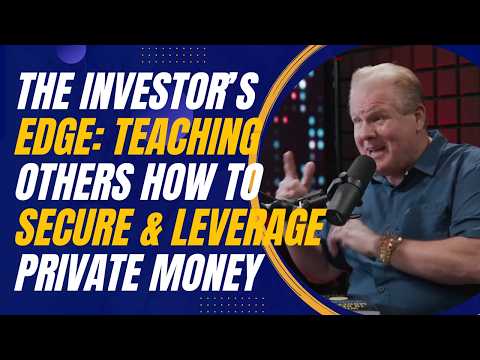
The Investor’s Edge: Teaching Others How to Secure and Leverage Private Real Estate Funds
36 View

- Publish Date:
- November 20, 2026
- Category:
- What Are Reits
- Video License
- Standard License
- Imported From:
- Youtube
#realestate #privatemoney #jayconner
Credits to:
https://www.youtube.com/watch?v=eJqUdD4vHrc
“Private Money Beats Bank Financing with Jay Conner ”
https://www.youtube.com/@Steven_Arita
The conversation focused on a transformative strategy for real estate investors: leveraging Private Money to fund deals, especially when traditional financing options are out of reach. The discussion explored personal stories, actionable tactics, and the mindset shifts needed to succeed in both raising private capital and putting it to effective use.
What Is Private Money and Why Does It Matter?
A key theme that emerged was distinguishing Private Money from hard money. While hard money often comes from institutional brokers who charge origination fees and high rates, Private Money is typically a one-on-one relationship between a borrower and a private individual, with no middlemen and much more favorable terms for both parties.
Operators (the investors seeking funds) can provide private lenders with strong collateral, straightforward terms, and, crucially, education about the process, since most potential lenders are unfamiliar with these strategies.
Educating, Not Pitching
The discussion explored the importance of shifting from a “begging for funds” mindset to becoming a “Private Money teacher.” Several points were raised, including the power of educating potential lenders within one’s own network, diagnosing their financial needs and pain points before ever presenting an investment opportunity.
Instead of chasing after money, the strategy involves pre-educating contacts about returns, security measures, and how their money will be protected—until they’re ready and eager for the “good news” call about a specific deal.
This approach not only helps build trust but also allows for more confident deal-making. Investors with Private Money commitments lined up can make more aggressive offers, scale their operations, and act with speed—sometimes closing deals within just seven days.
Win-Win Partnerships: Why Lenders Love Private Money
Security: Deals are typically collateralized by deeds of trust or mortgages, with insurance and conservative loan-to-value ratios, providing protections similar to what a bank would demand.
Flexibility: Terms often include features like a 90-day call option, allowing lenders to reclaim their money in the event of an emergency, usually with no penalty.
Transparency & Track Record: Lenders are encouraged to “know their operator,” i.e., only lend to trustworthy, proven investors who can demonstrate experience and transparency about each deal.
The Takeaway: Be Resourceful, Not Just Resourced
Private Money represents a resilient, relationship-based alternative to traditional real estate financing. The core message was that whether banks are lending or not, these strategies can be implemented by operators who are willing to educate themselves and their networks. The money, as emphasized, comes first—allowing for more deals, faster closings, and greater business scalability.
Timestamps:
00:00 Jay Conner on resourceful investing
05:36 Facing a financial crisis
08:43 Learning about Private Money
10:33 Pitching investment opportunities
16:15 Borrowing Tips and Lender Benefits
17:11 Private lending protections explained
21:09 Benefits of a Self-Directed IRA
25:00 Private lending for rehab properties
27:12 Benefits of Private Lending
32:29 Benefits of funding for operators
36:30 Explaining simple closing process
37:42 Potential risks and considerations
43:57 Private Money Conference details
46:10 Importance of financial education
Private Money Academy Conference:
https://www.ThePrivateMoneyConference.com
Free Report:
https://www.jayconner.com/MoneyReport
Join the Private Money Academy:
https://www.JayConner.com/trial/
Have you read Jay’s new book, Where to Get the Money Now?
It is available FREE (all you pay is the shipping and handling) at https://www.JayConner.com/Book
What is Private Money? Real Estate Investing with Jay Conner
http://www.JayConner.com/MoneyPodcast
Jay Conner is a proven leader in real estate investing. Without using his own money or credit, Jay uses creative methods to buy and sell properties, averaging $86,000 in profit per deal.
https://youtu.be/5sY02HwZ-NA
#RealEstate #RealEstateInvesting #RealEstateInvestingForBeginners #Foreclosures #FlippingHouses #PrivateMoney #RaisingPrivateMoney #JayConner
YouTube Channel
https://www.youtube.com/c/RealEstateInvestingWithJayConner
Apple Podcast:
https://podcasts.apple.com/us/podcast/private-money-academy-real-estate-investing-with-jay/id1377723034
Facebook:
https://www.facebook.com/jay.conner.marketing
Twitter:
https://twitter.com/JayConner01
Pinterest:
https://www.pinterest.com/JConner_PrivateMoneyAuthority